
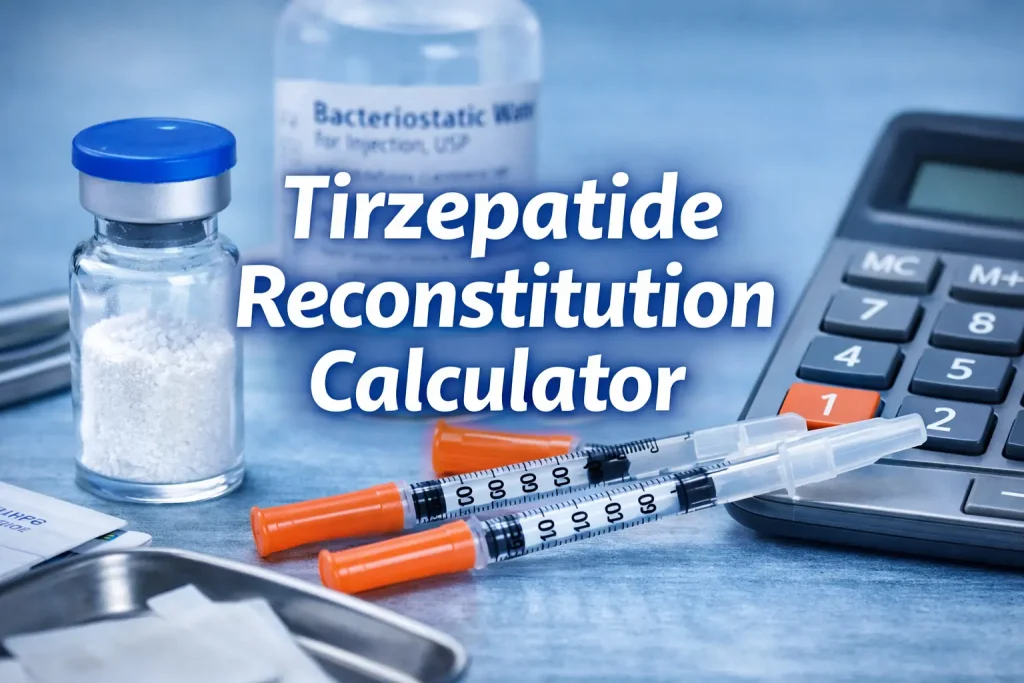
A tirzepatide reconstitution calculator helps determine how much bacteriostatic water to add and exactly how many syringe units equal your intended dose.
Instead of doing manual conversions, the peptide calculator instantly converts milligrams into measurable injection units for accurate preparation.
Enter your vial strength, dilution amount, and desired dose below to calculate your measurements quickly and confidently.
GET HELP WITH YOUR TIRZEPATIDE TREATMENT
Tirzepatide Reconstitution Calculator
Enter the following information:
- Vial strength (mg)
- Amount of bacteriostatic water added (mL)
- Desired dose (mg)
- Syringe type (U-100 insulin syringe)
Calculator Output:
- Final concentration after mixing
- mg per unit
- Units to draw per dose
- Injection volume
Try out our peptide dosing calculator to see how it works.
How Does Tirzepatide Reconstitution Work?
Reconstitution means mixing powdered tirzepatide with bacteriostatic water so the medication becomes a liquid that can be accurately measured.
Once mixed, the solution forms a specific concentration.
That concentration determines how many syringe units equal your intended dose.
Because every mixture can be different, a tirzepatide dilution calculator removes guesswork and helps prevent measurement errors.
How to Reconstitute Tirzepatide (Step-by-Step Mixing Guide)
While preparation instructions may vary, the general process typically includes:
- Clean both vial stoppers using an alcohol swab.
- Draw the selected amount of bacteriostatic water into a sterile syringe.
- Slowly inject the water into the vial, directing it toward the glass wall.
- Allow the powder to dissolve naturally without shaking.
- Gently swirl the vial until the solution becomes clear.
Avoid shaking aggressively, as this may affect solution stability.
Tirzepatide Reconstitution Calculator Formula
Understanding the basic calculation can help clarify how results are generated.
Formula:
- Total vial strength (mg) ÷ Amount of water added (mL) = Concentration (mg/mL)
Once concentration is known:
- Desired dose ÷ Concentration = Injection volume
The calculator automatically converts this volume into syringe units, simplifying the entire process.
Why Accurate Reconstitution Matters
Correct reconstitution directly affects dosing consistency.
If too little liquid is added, the solution becomes overly concentrated.
Adding too much liquid creates weaker concentrations that require larger injection volumes.
Using a tirzepatide dosage calculator helps ensure:
- Consistent weekly measurements
- Easier syringe readings
- Reduced dosing confusion
- Reliable preparation each time
Example Tirzepatide Reconstitution Scenarios
| Vial Size | Water Added | Final Concentration | Units for 2.5 mg Dose |
| 5 mg | 1 mL | 5 mg/mL | 50 units |
| 10 mg | 2 mL | 5 mg/mL | 50 units |
| 15 mg | 3 mL | 5 mg/mL | 50 units |
These examples show how different dilution choices can still produce easy-to-measure dosing when concentration remains consistent.
Tirzepatide Units to mg Conversion Explained
A common source of confusion involves converting milligrams into syringe units.
- Milligrams (mg) represent medication strength.
- Units represent liquid volume drawn into a syringe.
There is no universal unit measurement for tirzepatide because units depend entirely on how the medication was mixed.
A tirzepatide peptide calculator determines this relationship automatically after dilution.
How Much Bacteriostatic Water Should You Add?
There is flexibility in how much liquid can be added during mixing.
Many people select an amount that allows comfortable and precise syringe measurements.
Common dilution approaches include:
- 1 mL for smaller vials
- 2 mL for moderate vial strengths
- 3 mL or more for higher-strength vials
The goal is choosing a dilution that makes weekly dosing simple and repeatable.
Tirzepatide Units Chart Example
| Desired Dose | Concentration Example (5 mg/mL) | Syringe Units |
| 2.5 mg | 5 mg/mL | 50 units |
| 5 mg | 5 mg/mL | 100 units |
| 7.5 mg | 5 mg/mL | 150 units |
| 10 mg | 5 mg/mL | 200 units |
Always confirm your concentration after reconstitution before measuring doses.
Common Tirzepatide Reconstitution Mistakes
Many preparation errors occur during mixing rather than administration.
Common issues include adding bacteriostatic water too quickly, shaking the vial instead of gently swirling, forgetting to calculate final concentration, or assuming all vial strengths use identical syringe measurements.
A calculator helps eliminate these avoidable mistakes before dosing begins.
GET HELP WITH YOUR TIRZEPATIDE TREATMENT
Storage After Reconstitution
After mixing, tirzepatide is typically stored under refrigeration.
Best practices include:
- Keep refrigerated between uses
- Protect from direct light
- Avoid freezing
- Use sterile technique when drawing doses
Proper storage helps maintain solution stability throughout use.
Important Safety Considerations
Accurate calculations support consistent preparation, but dosing decisions should always follow guidance from a qualified healthcare provider.
Using sterile equipment, confirming dilution amounts, and measuring carefully all play important roles in safe administration.
A peptide calculator assists with measurement accuracy but does not replace professional medical direction.
FAQs: Tirzepatide Reconstitution Calculator
How to calculate tirzepatide doses?
Tirzepatide doses are calculated based on the final concentration after reconstitution. Divide the vial strength by the amount of bacteriostatic water added to determine mg per mL, then convert the desired dose into syringe units using a reconstitution calculator.
How to calculate reconstitution?
Reconstitution is calculated by dividing the total medication amount in milligrams by the volume of diluent added. This determines the concentration, which allows accurate dose measurement.
How much BAC water should you add to peptides?
The amount of bacteriostatic (BAC) water added depends on vial strength and preferred concentration. Many people choose a dilution that makes doses easy to measure using an insulin syringe while maintaining consistent accuracy.
How does peptide reconstitution work?
Peptide reconstitution involves adding bacteriostatic water to a powdered vial to create a liquid solution. Once dissolved, the medication can be measured precisely based on its concentration.
How do you reconstitute a vial?
To reconstitute a vial, slowly inject bacteriostatic water into the powdered medication, allow it to dissolve naturally, and gently swirl until the solution becomes clear. Avoid shaking the vial during mixing.