
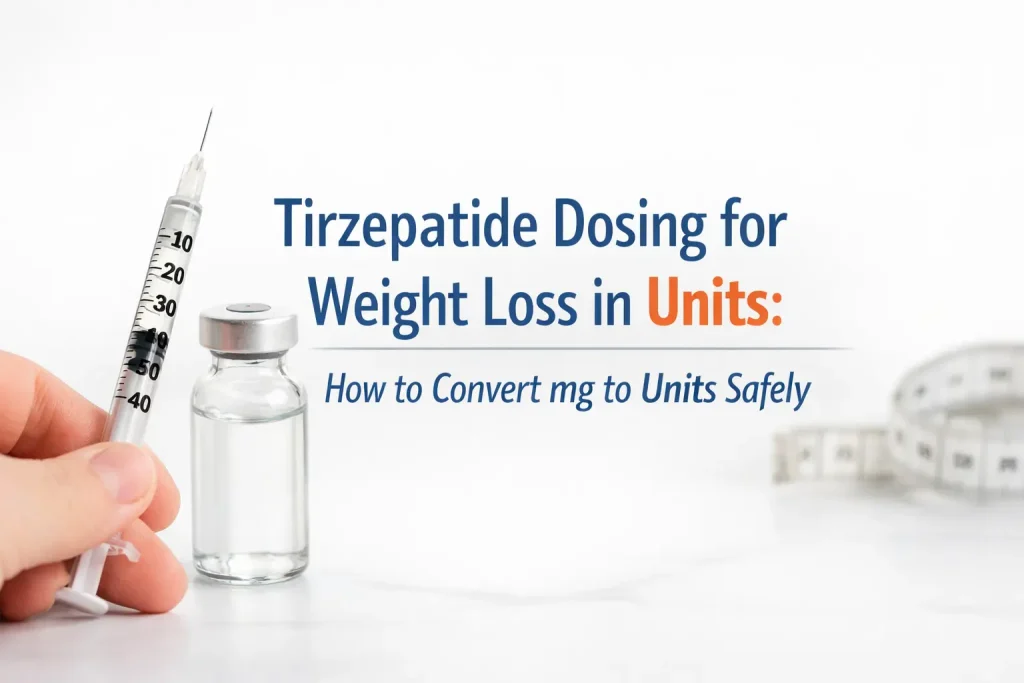
If you’ve been prescribed tirzepatide for weight loss, you may notice your prescription is written in milligrams (mg) while your syringe measures units.
That’s where confusion often starts.
Here’s the key point:
Tirzepatide dosing for weight loss is prescribed in mg, but the number of units you inject depends on the concentration of your vial.
There is no single “correct” units chart for everyone.
The right dose in units comes from a simple conversion based on your prescribed mg dose and the mg/mL listed on your medication label.
GET THE MOST OUT OF YOUR TIRZEPATIDE TREATMENT
Quick Answer: Tirzepatide Dosing for Weight Loss in Units
Tirzepatide is prescribed in mg once weekly, not units.
The number of units depends on your vial concentration:
- 2.5 mg ≈ 10–25 units
- 5 mg ≈ 20–50 units
- 7.5 mg ≈ 30–75 units
- 10 mg ≈ 40–100 units
Always confirm using the mg/mL concentration listed on your vial or with your provider.
Tirzepatide Dosing Schedule for Weight Loss (mg)
Tirzepatide is typically taken once weekly, with a gradual increase over time to reduce side effects and improve tolerance.
Standard dosing schedule:
- Weeks 1–4: 2.5 mg once weekly (starter dose)
- Weeks 5–8: 5 mg once weekly
- After that: increase by 2.5 mg every 4 weeks if needed
Common maintenance doses:
- 5 mg
- 10 mg
- 15 mg (maximum weekly dose)
Your provider may adjust this schedule based on tolerance, weight loss progress, and side effects.
Why Tirzepatide “Units” Can Be Confusing
Tirzepatide prescriptions are written in mg, but injections are measured in units on an insulin syringe.
Here’s how they differ:
- mg (milligrams) = how much medication you’re taking
- mL (milliliters) = liquid volume
- units = markings on your syringe (100 units = 1 mL)
Because tirzepatide vials come in different concentrations, the same mg dose may require different numbers of units depending on your formulation.
That’s why one chart might say 25 units for a dose while another says 10 units, both can be correct if the concentrations are different.
Tirzepatide mg vs Units (Simple Explanation)
Think of mg as the strength of your dose and units as the amount of liquid you draw up.
You always inject the same mg dose your provider prescribes, but the units change depending on how concentrated the medication is in your vial.
How to Convert Tirzepatide mg to Units
You only need one formula:
- Step 1: mL needed = prescribed mg ÷ vial concentration (mg/mL)
- Step 2: units = mL × 100 (if using a 100-unit insulin syringe)
Example
If your prescription is 5 mg and your vial concentration is 10 mg/mL:
- 5 ÷ 10 = 0.5 mL
- 0.5 × 100 = 50 units
Tirzepatide Units Chart by Concentration
Below are common examples to help you understand how conversions work.
Always confirm your vial concentration before using any chart.
If your vial is 10 mg/mL
| Dose (mg) | mL | Units |
| 2.5 mg | 0.25 mL | 25 units |
| 5 mg | 0.5 mL | 50 units |
| 7.5 mg | 0.75 mL | 75 units |
| 10 mg | 1.0 mL | 100 units |
If your vial is 12.5 mg/mL
| Dose (mg) | mL | Units |
| 2.5 mg | 0.2 mL | 20 units |
| 5 mg | 0.4 mL | 40 units |
| 7.5 mg | 0.6 mL | 60 units |
| 10 mg | 0.8 mL | 80 units |
| 12.5 mg | 1.0 mL | 100 units |
If your vial is 16.67 mg/mL
| Dose (mg) | mL | Units |
| 2.5 mg | 0.15 mL | 15 units |
| 5 mg | 0.3 mL | 30 units |
| 7.5 mg | 0.45 mL | 45 units |
| 10 mg | 0.6 mL | 60 units |
| 12.5 mg | 0.75 mL | 75 units |
| 15 mg | 0.9 mL | 90 units |
If your vial is 25 mg/mL
| Dose (mg) | mL | Units |
| 2.5 mg | 0.1 mL | 10 units |
| 5 mg | 0.2 mL | 20 units |
| 7.5 mg | 0.3 mL | 30 units |
| 10 mg | 0.4 mL | 40 units |
| 12.5 mg | 0.5 mL | 50 units |
| 15 mg | 0.6 mL | 60 units |
How Many Units Is Tirzepatide for Weight Loss?
The exact number depends on your vial concentration, but here’s a general reference range:
- 2.5 mg: often 10–25 units
- 5 mg: often 20–50 units
- 7.5 mg: often 30–75 units
- 10 mg: often 40–100 units
- 12.5 mg: often 50–100 units
- 15 mg: often 60–100 units
Always verify using your vial concentration.
Why One Chart Says 25 Units and Another Says 10 Units
This is one of the most common questions patients ask.
Different pharmacies and formulations use different concentrations.
For example:
- A 10 mg/mL vial requires more liquid volume
- A 25 mg/mL vial requires less liquid volume
Both charts can be accurate, they just apply to different formulations.
Common Mistakes to Avoid
Most dosing errors happen for simple reasons.
Watch for these:
- Using a chart that doesn’t match your vial
- Confusing mg with units
- Skipping dose increases or moving too quickly
- Taking tirzepatide more than once weekly
- Guessing instead of checking your prescription label
If you’re unsure, pause and confirm before injecting.
What to Do If You Miss a Dose
If you miss your weekly injection:
- Take it within 4 days (96 hours) if possible
- If more than 4 days have passed, skip it and take your next dose as scheduled
Do not double your dose to make up for a missed injection.
When to Talk to Your Provider
Reach out if you experience:
- Persistent nausea or vomiting
- Trouble tolerating dose increases
- Minimal weight loss after several months
- Uncertainty about your units or syringe measurement
Your provider can adjust your dosing plan safely.
Can BHRT Delivered Help?
At BHRT Delivered, dosing is personalized from the start.
Our team helps you:
- Understand your prescribed mg dose
- Confirm your vial concentration
- Convert mg to units accurately
- Adjust dosing safely as your treatment progresses
With provider-guided titration and medication shipped directly to your door, you always have support when your dose changes or questions come up.
Final Takeaway: Tirzepatide Dosing for Weight Loss in Units
Tirzepatide dosing for weight loss is always prescribed in mg.
The number of units you inject depends entirely on your vial concentration and syringe type.
When in doubt, double-check your label or ask your provider.
Taking a few extra seconds to confirm your dose helps keep your treatment safe and effective.
FAQs: Tirzepatide Dosing for Weight Loss in Units
How long does it take to lose 20 lbs on tirzepatide?
Studies show weight loss varies by person, but many people lose weight gradually over several months. Some may reach 20 lbs in 3–6 months with consistent dosing, nutrition, and lifestyle support.
How long should you stay on tirzepatide?
Many patients stay on tirzepatide long term if it’s effective and well tolerated. Your provider will determine the duration based on your weight goals, health history, and response to treatment.
What are the drawbacks of tirzepatide?
Common drawbacks include nausea, digestive discomfort, appetite changes, and cost. Some people also find weekly injections inconvenient.
Can you keep weight off after getting off tirzepatide?
Yes, but it depends on maintaining lifestyle habits. Many people regain some weight after stopping, so nutrition, activity, and follow-up care are important.
What is considered a microdose of tirzepatide?
There’s no official definition. Some people informally use the term for doses lower than standard starting levels, but tirzepatide should always be used as prescribed by your provider.