
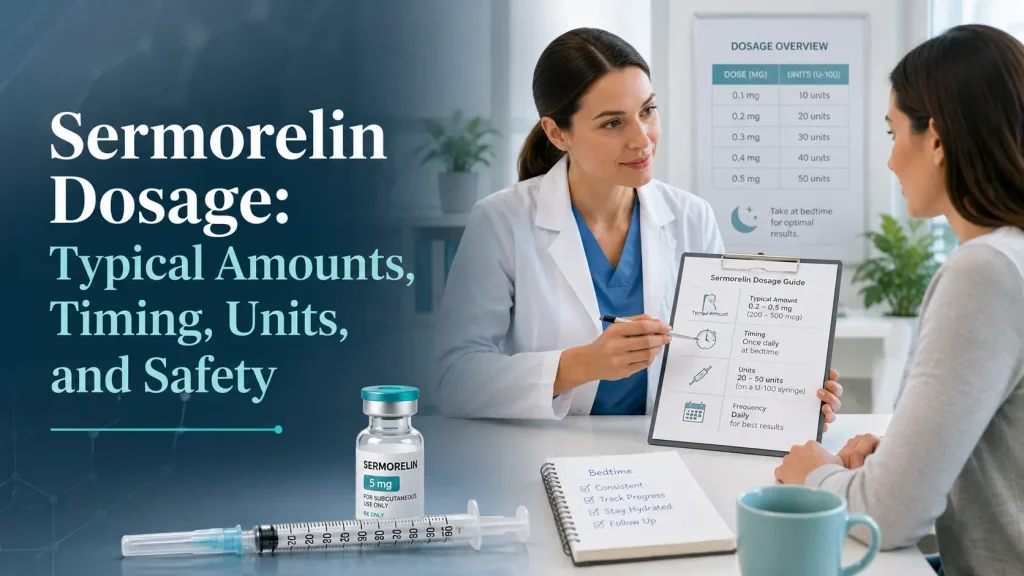
A common adult sermorelin dosage discussed in compounded treatment protocols is approximately 200 to 500 micrograms per injection, with some providers starting closer to 200 or 300 micrograms.
However, there is no universal adult dose.
The right amount depends on your prescription, medication concentration, laboratory results, health history, treatment goals, and response over time.
Sermorelin doses are usually written in micrograms (mcg) or milligrams (mg).
The amount drawn into a syringe may be listed in units, but syringe units measure liquid volume rather than a fixed amount of medication.
That means 20 units of one sermorelin preparation may contain a different dose than 20 units of another.
Always follow the dose and concentration listed on your prescription rather than copying an online chart or another patient’s instructions.
Sermorelin Dosage at a Glance
| Question | General answer |
|---|---|
| What is a commonly discussed adult dose? | Approximately 200 to 500 mcg per injection in some compounded protocols |
| When is sermorelin commonly taken? | In the evening or near bedtime |
| Is it taken every day? | Some plans use nightly dosing, while others use selected nights |
| How many syringe units should you use? | It depends on the prescribed dose and medication concentration |
| Can you adjust the dose yourself? | No. Dose changes should be made by the prescribing clinician |
| Is a 5 mg vial one dose? | No. It usually refers to the total amount in the vial |
These figures are educational examples, not personalized dosing instructions.
What Is Sermorelin?
Sermorelin is a synthetic version of the first 29 amino acids of growth hormone-releasing hormone, often abbreviated as GHRH.
It works by signaling the pituitary gland to release growth hormone.
Growth hormone can then influence the production of insulin-like growth factor 1, or IGF-1, along with several processes related to metabolism, tissue repair, body composition, and recovery.
This mechanism is different from administering growth hormone directly.
Sermorelin depends on the pituitary gland’s ability to respond to the signal.
Because of this, a provider may consider more than symptoms when deciding whether sermorelin is appropriate.
Laboratory testing, thyroid function, glucose regulation, medical history, current medications, sleep patterns, and other hormones may all affect the treatment plan.
Sermorelin Dosage Per Day: What Is Typically Prescribed?
There is no single adult sermorelin dosage per day that applies to every patient.
In current compounded treatment settings, adult doses are often discussed in the range of a few hundred micrograms per injection.
Approximately 200 to 500 mcg is a commonly cited range, although some prescriptions may fall outside it.
A provider may start with a lower amount and evaluate how the patient responds before making any changes.
The starting dose may be influenced by:
- Baseline symptoms
- Age
- IGF-1 levels
- Thyroid health
- Metabolic health
- Previous treatment
- Medication tolerance
- Treatment goals
- Other prescriptions or supplements
A higher dose is not automatically more effective.
Increasing the amount without medical guidance may raise the likelihood of unwanted effects without improving the outcome.
Sermorelin mg-to-mcg conversion
| Milligrams | Micrograms |
| 0.1 mg | 100 mcg |
| 0.2 mg | 200 mcg |
| 0.3 mg | 300 mcg |
| 0.4 mg | 400 mcg |
| 0.5 mg | 500 mcg |
| 1 mg | 1,000 mcg |
| 5 mg | 5,000 mcg |
This table only converts milligrams to micrograms.
It does not tell you how many units to draw into a syringe.
Sermorelin Dosage Chart: mcg, mg, mL, and Units
Four different measurements may appear on a sermorelin prescription or vial.
| Dosage term | What it measures | Example |
| Prescribed dose | The amount of sermorelin ordered | 300 mcg |
| Concentration | The amount of sermorelin in each mL | 1 mg/mL |
| Injection volume | The liquid drawn into the syringe | 0.3 mL |
| Syringe units | Volume markings on a U-100 syringe | 30 units |
These measurements are related, but they are not interchangeable.
A prescription for 300 mcg tells you the amount of sermorelin to use.
It does not tell you how far to fill the syringe until you also know the concentration.
Sermorelin Dosage in Units: Converting mcg to Syringe Units
There is no universal sermorelin dosage in units because syringe units measure volume.
On a U-100 insulin syringe:
| Syringe marking | Liquid volume |
| 100 units | 1 mL |
| 50 units | 0.5 mL |
| 30 units | 0.3 mL |
| 20 units | 0.2 mL |
| 10 units | 0.1 mL |
| 5 units | 0.05 mL |
| 1 unit | 0.01 mL |
The amount of sermorelin inside that volume depends on how concentrated the medication is.
The basic conversion formula
When the prescribed dose and concentration use matching units:
Prescribed dose ÷ concentration = injection volume
For a U-100 syringe:
Injection volume in mL × 100 = syringe units
For example, suppose the prescription calls for 200 mcg and the concentration is 1,000 mcg/mL:
200 mcg ÷ 1,000 mcg/mL = 0.2 mL
Then:
0.2 mL × 100 = 20 units
This calculation only applies when the concentration is exactly 1,000 mcg/mL, which is the same as 1 mg/mL.
Sermorelin Dosage by Concentration
The following table shows how the same prescribed dose can require different syringe markings when the medication concentration changes.
| Prescribed dose | Concentration | Injection volume | U-100 syringe units |
| 200 mcg | 1 mg/mL | 0.2 mL | 20 units |
| 200 mcg | 2 mg/mL | 0.1 mL | 10 units |
| 200 mcg | 2.5 mg/mL | 0.08 mL | 8 units |
| 300 mcg | 1 mg/mL | 0.3 mL | 30 units |
| 300 mcg | 2 mg/mL | 0.15 mL | 15 units |
| 300 mcg | 2.5 mg/mL | 0.12 mL | 12 units |
| 500 mcg | 1 mg/mL | 0.5 mL | 50 units |
| 500 mcg | 2 mg/mL | 0.25 mL | 25 units |
| 500 mcg | 2.5 mg/mL | 0.2 mL | 20 units |
These examples are mathematical conversions only.
They are not recommendations for how much sermorelin to take.
Your prescription label should list the dose, concentration, and injection instructions.
Contact the prescribing office or pharmacy when those numbers do not appear to match.
How Many Units Is 200 mcg of Sermorelin?
The number of units depends on the concentration.
- At a concentration of 1 mg/mL, 200 mcg equals 0.2 mL, or 20 units on a U-100 syringe.
- At a concentration of 2 mg/mL, 200 mcg equals 0.1 mL, or 10 units.
- At a concentration of 2.5 mg/mL, 200 mcg equals 0.08 mL, or 8 units.
All three calculations represent the same 200 mcg dose.
The syringe marking changes because the medication strength changes.
How Many Units Is 300 mcg of Sermorelin?
At 1 mg/mL, 300 mcg equals 0.3 mL, or 30 U-100 syringe units.
At 2 mg/mL, 300 mcg equals 0.15 mL, or 15 units.
At 2.5 mg/mL, 300 mcg equals 0.12 mL, or 12 units.
Do not assume that another person’s 300 mcg prescription uses the same syringe marking as yours.
Is 20 Units of Sermorelin a Typical Dose?
Twenty units is a volume, not a complete dosage.
On a U-100 syringe, 20 units equals 0.2 mL.
The amount of sermorelin in that volume depends on the concentration.
For example:
| Concentration | Amount contained in 20 units |
| 1 mg/mL | 200 mcg |
| 2 mg/mL | 400 mcg |
| 2.5 mg/mL | 500 mcg |
This is why a prescription that only says “20 units” should also be connected to a specific vial concentration.
What Does a 5 mg Sermorelin Vial Mean?
A vial labeled 5 mg generally contains 5 milligrams of sermorelin in total. It does not mean that 5 mg should be taken in one injection.
Five milligrams equals 5,000 micrograms.
The number of possible doses depends on the amount prescribed per injection.
| Prescribed amount | Mathematical number of doses in 5 mg |
| 100 mcg | 50 doses |
| 200 mcg | 25 doses |
| 250 mcg | 20 doses |
| 300 mcg | Approximately 16 full doses |
| 400 mcg | Approximately 12 full doses |
| 500 mcg | 10 doses |
These figures do not account for medication left in the vial or syringe, pharmacy beyond-use dates, measurement loss, or product-specific instructions.
The total milligrams in the vial also do not reveal the concentration.
To calculate syringe units, you still need to know how many milligrams or micrograms are present in each milliliter.
How Many Doses Are in a 5 mg Vial of Sermorelin?
A 5 mg vial contains 5,000 mcg in total.
Mathematically, it could provide 25 doses at 200 mcg, 20 doses at 250 mcg, 16 full doses at 300 mcg, or 10 doses at 500 mcg.
However, the actual usable number may differ based on:
- The pharmacy’s preparation instructions
- The final concentration
- Medication left in the vial
- Syringe measurement loss
- The beyond-use date
- Changes in the prescribed dose
Use the schedule and vial instructions supplied with your prescription rather than dividing the vial independently.
What Factors Determine Your Sermorelin Dose?
A provider may consider several factors before selecting or adjusting a dose.
Treatment goals
Patients may ask about sermorelin for sleep, energy, recovery, body composition, or age-related changes.
A treatment goal helps guide the evaluation, but it does not establish the dose by itself.
IGF-1 and other laboratory findings
Growth hormone stimulates the production of IGF-1.
A provider may review IGF-1 alongside symptoms, age, health history, and other laboratory markers.
A single lab result does not automatically determine the prescription.
Thyroid function
Low thyroid function may affect growth hormone signaling and treatment response.
Thyroid symptoms or abnormal laboratory findings may need to be addressed as part of the overall plan.
Glucose and metabolic health
Growth hormone influences metabolism and glucose regulation.
A provider may consider fasting glucose, hemoglobin A1C, insulin resistance, body composition, and related health concerns.
Age and body composition
Growth hormone secretion tends to change with age.
Body composition, sleep, nutrition, stress, and activity level can also affect hormone physiology.
These factors make universal age-based or weight-based adult charts unreliable.
Other medications and hormones
Prescription medications, supplements, estrogen, testosterone, thyroid medication, and other treatments may affect the evaluation.
Your provider should have an accurate list of everything you are taking.
Treatment response
Follow-up may include symptom changes, side effects, adherence, injection technique, and laboratory testing.
A dose may remain the same, be adjusted, or be discontinued depending on the overall response.
When Is the Best Time to Take Sermorelin?
Sermorelin is commonly prescribed in the evening or close to bedtime.
Growth hormone is released in pulses, and a substantial portion of natural secretion occurs during sleep.
Evening administration is intended to work with this nighttime pattern.
However, the exact timing may vary.
Follow the schedule provided with your prescription, especially when it includes instructions about meals or fasting.
Should Sermorelin Be Taken on an Empty Stomach?
Some providers recommend separating sermorelin from food, particularly meals high in carbohydrates.
Food intake and insulin activity can influence growth hormone physiology, which is why some treatment plans include a fasting window before or after the injection.
There is no single meal-timing rule that applies to every compounded prescription.
Use the instructions supplied by your clinician or pharmacy rather than creating your own fasting schedule.
How Often Is Sermorelin Taken?
Sermorelin may be prescribed:
- Every night
- Five nights per week
- On selected nights
- According to another individualized schedule
The frequency may depend on the prescribed amount, treatment goals, provider approach, tolerance, and laboratory response.
A five-night schedule should not be changed to seven nights without guidance.
Likewise, a nightly prescription should not be reduced based on a schedule found online.
Sermorelin Dosage for Weight Loss
There is no established sermorelin dosage that guarantees weight loss.
Sermorelin does not primarily work by suppressing appetite.
It stimulates growth hormone signaling through the pituitary gland.
Growth hormone has metabolic effects, including effects on fat metabolism, but this does not mean sermorelin will produce predictable weight loss in every patient.
When body composition is a goal, a provider may also evaluate:
- Calorie intake
- Protein intake
- Physical activity
- Resistance training
- Sleep quality
- Thyroid function
- Sex hormones
- Insulin resistance
- Stress
- Medications associated with weight gain
A stalled result does not automatically mean the dose should be increased.
Sermorelin Dosage for Muscle Growth and Recovery
There is no universal sermorelin dosage for bodybuilding, muscle growth, or athletic recovery.
Growth hormone and IGF-1 participate in tissue growth and metabolism, which explains the interest in sermorelin for lean body composition and recovery.
However, sermorelin is not an anabolic steroid and does not replace training, nutrition, protein intake, sleep, or adequate recovery.
Results may differ by age, sex, hormone status, activity level, and baseline health.
Competitive athletes should also verify whether sermorelin is prohibited by the rules governing their sport.
Is Sermorelin Dosage Different for Men and Women?
Men and women may have differences in growth hormone physiology, but sex alone does not determine the correct dose.
A provider may also consider:
- Menopausal or menstrual status
- Estrogen or testosterone levels
- Hormone treatment
- IGF-1
- Thyroid function
- Body composition
- Symptoms
- Medical history
- Treatment tolerance
There is not one standard male dose and one standard female dose.
How Is Sermorelin Dosage Adjusted?
Dosage changes should be based on follow-up with the prescribing clinician.
The provider may review:
- Whether doses are being taken consistently
- Injection technique
- Storage conditions
- Changes in symptoms
- Side effects
- IGF-1 or other laboratory results
- Changes in other medications
- Whether the original treatment goal remains appropriate
The treatment plan may stay the same, change in amount or frequency, pause, or stop.
Do not increase the dose simply because you do not notice immediate changes.
Signs Your Sermorelin Dosage May Need to Be Reviewed
Contact your provider when you experience persistent or concerning symptoms after starting treatment or changing the dose.
Reasons for review may include:
- Ongoing redness, pain, or swelling at the injection site
- Headaches
- Dizziness
- Flushing
- Unusual sleepiness
- Swelling or fluid retention
- Changes in blood sugar
- Worsening symptoms
- No meaningful response after an appropriate follow-up period
- Difficulty measuring the dose
- A new vial with a different concentration
Seek prompt medical attention for trouble breathing, facial or throat swelling, difficulty swallowing, or other signs of a serious allergic reaction.
What Should You Do If You Miss a Sermorelin Dose?
Follow the missed-dose instructions provided with your prescription.
Do not automatically double the next injection.
The appropriate next step may depend on when the dose was missed and how close you are to the next scheduled injection.
Contact the prescribing office or pharmacy if the label does not provide clear instructions.
How Long Do People Take Sermorelin?
There is no standard treatment duration for every patient.
The length of treatment may depend on:
- Why treatment was started
- Symptom response
- Laboratory findings
- Side effects
- Adherence
- Changes in health
- Whether the expected benefits continue to outweigh the risks
Sermorelin is sometimes discussed in terms of treatment “cycles,” but an arbitrary cycle length should not replace clinical monitoring.
How to Store Sermorelin
Storage instructions depend on the preparation and pharmacy.
Compounded sermorelin is commonly stored in the refrigerator and should not be frozen, but the label supplied with your prescription should take priority.
Review the pharmacy instructions for:
- Refrigeration
- Protection from light
- Beyond-use date
- Travel storage
- What to do if the vial becomes warm
- Whether cloudy or discolored medication should be used
Do not use a vial that has been frozen, stored incorrectly, damaged, or kept beyond its stated date without first contacting the pharmacy.
How to Use Sermorelin Safely
Correct dosing also depends on proper storage, syringe selection, and injection technique.
Use the syringe type recommended by the pharmacy.
Rotate injection sites rather than repeatedly using the same location.
Depending on the instructions, common subcutaneous areas may include the abdomen, thigh, hip, or upper arm.
Never share needles, syringes, or medication vials.
Place used needles in an appropriate sharps container.
A concentrated medication can require a very small volume.
Ask the pharmacy to demonstrate the correct syringe marking if the prescribed amount is difficult to measure.
Get an Individualized Sermorelin Treatment Plan
An online sermorelin dosage chart can help explain mcg, mg, mL, and syringe units, but it cannot determine the right prescription for your body.
A treatment plan should account for your symptoms, medical history, laboratory results, current medications, treatment goals, and response over time.
The prescribed amount must also be matched to the pharmacy concentration so the correct volume can be measured.
BHRT Delivered provides clinician-guided evaluation and personalized treatment support for qualifying patients across the United States.
When sermorelin is considered appropriate, the dosage and schedule are based on the individual patient rather than a one-size-fits-all chart.
Schedule a consultation with BHRT Delivered to discuss your symptoms, goals, and whether sermorelin may be appropriate for your treatment plan.
FAQs: Sermorelin Dosage
What is the typical sermorelin dosage?
Adult compounded protocols often discuss approximately 200 to 500 mcg per injection. However, there is no universal adult dose. The prescribed amount should reflect the patient’s health history, laboratory results, goals, medication concentration, and response.
Why is sermorelin commonly taken before bed?
Growth hormone is naturally released in pulses, with significant secretion occurring during sleep. Evening dosing is commonly used to work with that pattern.
Can I eat before or after taking sermorelin?
Meal-timing instructions vary. Some providers recommend leaving time between food and the injection, particularly after a carbohydrate-heavy meal.
Can I increase my sermorelin dosage if it is not working?
Do not increase the dose yourself. Lack of progress may relate to timing, adherence, storage, injection technique, thyroid health, metabolic factors, unrealistic expectations, or the need for further evaluation.
Does body weight determine the sermorelin dose?
Adult sermorelin dosage is not determined by body weight alone. Pediatric weight-based research should not be copied for adult treatment.