
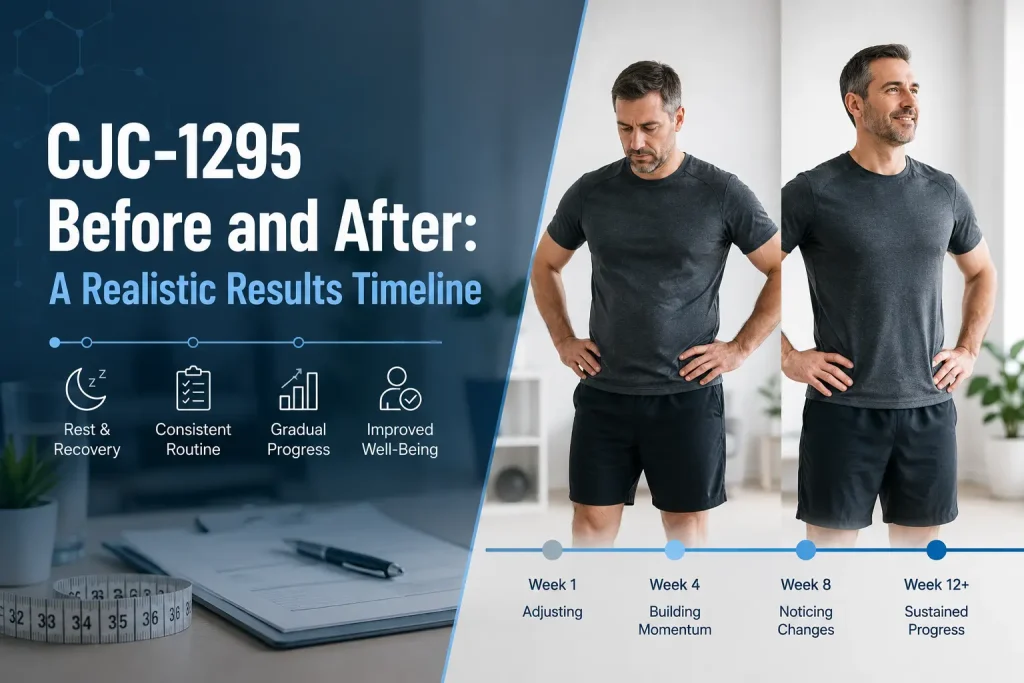
CJC-1295 before-and-after results are usually gradual rather than immediate.
Some people report noticing changes in sleep, energy, or workout recovery within the first few weeks.
Changes in waist measurements, body composition, muscle definition, or physical appearance may take several months to assess, if they occur at all.
Results can vary based on your age, baseline hormone levels, health history, sleep, nutrition, exercise routine, treatment consistency, other therapies, and the specific CJC-1295 formulation being used.
Let’s dive into what affects CJC-1295, how to get the best results and whether CJC-1295 is right for you.
CJC-1295 Results at a Glance
Some people report changes in sleep, energy, or recovery within two to four weeks of starting CJC-1295 with ipamorelin.
Measurable body-composition changes, when they occur, may take eight to twelve weeks or longer.
These time frames are based largely on reported experiences and clinical observations.
Human studies have shown that CJC-1295 can increase growth hormone and insulin-like growth factor 1, or IGF-1, but research has not established a guaranteed timeline for fat loss, muscle gain, better sleep, or visible physical changes.
The best way to evaluate progress is to compare baseline symptoms, measurements, photographs, exercise performance, and provider-selected laboratory markers over time.
What Is CJC-1295?
CJC-1295 is a synthetic growth hormone-releasing hormone analog, commonly called a GHRH analog.
It signals the pituitary gland to release more of the body’s own growth hormone.
Growth hormone is involved in several biological processes, including:
- Tissue repair
- Metabolism
- Muscle maintenance
- Fat utilization
- Bone health
- Sleep and recovery
- IGF-1 production
CJC-1295 does not directly provide growth hormone.
Instead, it stimulates the body’s existing growth hormone system.
Human research involving a long-acting CJC-1295 formulation found that it produced sustained increases in growth hormone and IGF-1 in healthy adults.
However, the study focused on hormone levels, pharmacokinetics, and short-term safety.
It did not establish predictable changes in body fat, muscle mass, skin, sleep, or physical appearance.
That distinction is important when interpreting CJC-1295 before-and-after claims.
What Can Change Before and After CJC-1295?
The word “results” can mean several different things.
Someone may experience a laboratory change without noticing a visible difference, while another person may report better sleep without seeing a substantial change in IGF-1.
CJC-1295 results generally fall into three categories.
Laboratory Changes
Bloodwork may show a change before you notice anything physically.
IGF-1 is one laboratory marker a provider may evaluate because growth hormone stimulates IGF-1 production.
A change in IGF-1 confirms that a biological response may be occurring.
It does not guarantee fat loss, muscle growth, better sleep, or increased energy.
Subjective Changes
Subjective changes are improvements a person feels but that may not appear on a photograph or single laboratory test.
Examples may include:
- Better perceived sleep quality
- More morning energy
- Less post-workout soreness
- Faster perceived recovery
- Greater exercise consistency
- An improved sense of well-being
These experiences can be meaningful, but they can also be affected by expectations, stress, nutrition, exercise, sleep habits, medications, and other treatments.
Objective Changes
Objective changes can be documented using repeatable measurements.
These may include:
- Waist circumference
- Body weight
- Body-fat percentage
- Lean mass
- Strength
- Training volume
- Sleep duration
- Standardized photographs
- Laboratory markers
Objective measurements make it easier to determine whether a consistent trend is developing.
What Does the Evidence Support?
Research on CJC-1295 and ipamorelin is more limited than many online before-and-after claims suggest.
| Outcome | What the Available Evidence Supports |
|---|---|
| Increased growth hormone and IGF-1 | Demonstrated in short-term human research involving long-acting CJC-1295 |
| Growth hormone release from ipamorelin | Demonstrated in a human pharmacology study |
| Better sleep or recovery | Frequently reported, but not established through large, long-term trials of the combination |
| Fat loss or muscle gain | Biologically plausible, but no predictable amount has been established |
| Skin or anti-aging changes | Limited direct human evidence |
| Long-term safety | Not fully established through large, long-duration studies |
The available human studies help explain how these peptides affect hormone signaling.
They do not prove that every person will experience a visible transformation or that changes will occur on a specific schedule.
How Long Does CJC-1295/Ipamorelin Take to Show Results?
People searching for “CJC 1295 ipamorelin how long to see results” are often hoping for an exact week-by-week answer.
In practice, the response varies considerably.
Some people report sleep, energy, or recovery changes during the first several weeks.
Changes in strength, waist size, body composition, or appearance may require eight to twelve weeks or longer to evaluate.
The following timeline is a practical guide rather than a guaranteed sequence.
| Time Period | What May Be Evaluated | What to Track |
| Before treatment | Baseline symptoms, measurements and laboratory markers | Sleep, energy, waist, weight, body composition, recovery and provider-selected bloodwork |
| Weeks 1–4 | Tolerance and early subjective changes | Sleep, energy, soreness, recovery and side effects |
| Weeks 5–8 | More consistent symptom or performance trends | Workout frequency, strength, waist, weight and sleep quality |
| Months 2–3 | Early objective changes may become easier to assess | Photographs, body composition, measurements, performance and laboratory markers |
| Months 3–6 | Overall treatment response becomes clearer | Sustained benefits, side effects, physical changes and treatment goals |
| After six months | The value of continuing treatment can be reassessed | Measurable benefits, risks, cost, goals and provider recommendations |
Not seeing a visible change during the first month does not automatically mean the treatment is ineffective.
At the same time, an increase in IGF-1 does not guarantee that a physical transformation will eventually occur.
CJC-1295 Results Timeline: One Month to Six Months
Let’s take a look at the typical CJC-1295 results timeline:
CJC-1295 Results During the First Month
The first month is generally too early to judge a complete before-and-after transformation.
Early follow-up is more useful for determining:
- Whether the treatment is well tolerated
- Whether side effects are developing
- Whether sleep or energy patterns are changing
- Whether workout recovery feels different
- Whether the treatment plan is practical to follow
Some people report deeper sleep, vivid dreams, improved energy, or less post-workout soreness.
Others notice little or no difference.
Body weight and photographs may remain largely unchanged during this period.
Daily scale fluctuations can also reflect hydration, sodium intake, digestion, and other factors rather than meaningful changes in body fat.
CJC-1295 Results After Six to Eight Weeks
By six to eight weeks, it may be easier to determine whether early changes are consistent rather than temporary.
Someone who initially reported better sleep can review whether the improvement has continued.
An active person can compare soreness, workout frequency, performance, and recovery time with their baseline.
Possible reported changes during this stage may include:
- More consistent sleep
- Better perceived exercise recovery
- Improved daytime energy
- Greater workout consistency
- Early changes in waist measurements
- Increased exercise tolerance
These changes should still be interpreted carefully.
Starting a new exercise program, eating differently, improving sleep, or beginning another therapy at the same time can make it difficult to determine what caused the result.
CJC-1295 Results After Three Months
Three months usually provides a more useful comparison point than the first several weeks.
By this stage, a provider may be able to compare:
- Baseline and follow-up symptoms
- Waist circumference
- Body weight
- Body composition
- Exercise performance
- Sleep patterns
- Laboratory markers
- Side effects
Someone focused on body composition may notice that clothing fits differently or that waist measurements have changed.
Another person may experience better workout consistency without seeing a dramatic physical difference.
Scale weight alone cannot determine whether someone gained muscle, lost fat, retained water, or experienced several changes at once.
Body-composition testing and waist measurements can provide additional context.
CJC-1295 Results After Six Months
By three to six months, the overall response should be easier to evaluate.
Useful questions include:
- Has sleep improved consistently?
- Is post-exercise recovery noticeably different?
- Have waist or body-composition measurements changed?
- Has strength improved beyond normal training progression?
- Have laboratory markers responded appropriately?
- Are the benefits meaningful enough to continue?
- Have side effects affected daily life?
Remaining on treatment longer does not guarantee that results will become increasingly dramatic.
If the intended benefits have not appeared, the care plan should be reassessed rather than continued solely in the hope of a later transformation.
CJC-1295 Before-and-After Results by Goal
Let’s take a look at some results across different goals:
Sleep and Daytime Energy
Some people report deeper sleep, fewer nighttime awakenings, or feeling more rested in the morning.
Sleep changes may be among the first effects a person notices because they can be evaluated from one day to the next.
However, sleep is influenced by many factors, including:
- Stress
- Alcohol
- Sleep apnea
- Menopause
- Testosterone levels
- Thyroid function
- Medications
- Caffeine
- Bedtime habits
A sleep log can help determine whether a change is consistent.
Track bedtime, wake time, nighttime awakenings, total sleep duration, and morning energy.
Persistent fatigue should not automatically be attributed to growth hormone signaling.
Other health concerns may need to be evaluated.
Exercise Recovery
Some people use CJC-1295 as part of a medically supervised plan focused on recovery, exercise consistency, and overall performance.
A useful recovery comparison may include:
- How long soreness lasts
- Whether performance drops during the next workout
- How many planned sessions are completed
- Total weekly training volume
- Sleep quality
- Resting heart rate
- Recurring pain or injuries
Feeling less sore does not necessarily prove that tissue is healing faster.
It is one part of the overall assessment.
Persistent or worsening pain should be evaluated rather than treated as a normal part of training.
Muscle and Strength
Growth hormone and IGF-1 are involved in tissue growth and repair, which is why CJC-1295 is often associated with lean mass and exercise recovery.
However, CJC-1295 does not replace:
- Resistance training
- Adequate protein
- Sufficient calories
- Progressive exercise
- Recovery
- Sleep
An increase in strength may result from improved technique, better training consistency, increased confidence, nutrition changes, or normal adaptation to resistance exercise.
To track muscle-related progress, record exercises, repetitions, resistance, total training volume, circumference measurements, and body-composition trends.
Human CJC-1295 research has not established a guaranteed amount of muscle growth.
Fat Loss and Body Composition
CJC-1295 is frequently discussed in relation to fat loss because growth hormone is involved in lipolysis, the process through which stored fat is broken down.
This does not mean CJC-1295 causes a predictable amount of weight loss.
Changes in body fat are also strongly influenced by:
- Calorie intake
- Protein intake
- Physical activity
- Sleep
- Stress
- Age
- Insulin sensitivity
- Sex hormone levels
- Other medications or therapies
CJC-1295 should not be expected to compensate for an eating pattern that consistently provides more energy than the body uses.
Progress should be assessed with more than the scale.
A stable body weight combined with a smaller waist and increased lean mass may represent a meaningful change in body composition.
Skin and Physical Appearance
Growth hormone and IGF-1 are involved in tissue maintenance, so CJC-1295 is sometimes promoted for skin quality, elasticity, and a more youthful appearance.
Direct human evidence showing that CJC-1295 reduces wrinkles or produces a predictable cosmetic transformation is limited.
Changes in appearance may also result from:
- Hydration
- Weight loss
- Better sleep
- Skin care
- Lighting
- Camera settings
- Makeup
- Sun exposure
- Fluid retention
Claims that someone will look a specific number of years younger should be viewed cautiously.
CJC-1295 Alone vs. CJC-1295 With Ipamorelin
CJC-1295 and ipamorelin are frequently discussed together because they influence growth hormone release through different signaling pathways.
CJC-1295 acts as a GHRH analog.
Ipamorelin is a growth hormone secretagogue that acts through the ghrelin receptor.
Human research has shown that ipamorelin can stimulate growth hormone release.
However, the available study focused on pharmacokinetics, hormone response, and dose relationships.
It did not evaluate long-term fat loss, muscle growth, sleep, or before-and-after transformations.
The two peptides may be combined to support growth hormone signaling through complementary pathways.
That does not mean the combination has been proven to produce a specific amount of muscle gain, fat loss, or physical change.
CJC-1295 alone may still affect growth hormone and IGF-1.
Adding ipamorelin introduces a second signal intended to stimulate growth hormone release through a different receptor.
More stimulation is not automatically better.
Higher hormone markers do not always produce greater physical benefits and may increase the risk of unwanted effects.
The appropriate approach depends on the individual’s symptoms, health history, laboratory results, goals, response, and provider judgment.
CJC-1295 With DAC vs. Without DAC
The terminology surrounding CJC-1295 is often inconsistent.
The phrase “CJC-1295 without DAC” is commonly used online to describe a shorter-acting peptide associated with Modified GRF 1-29.
It should not automatically be treated as identical to the long-acting CJC-1295 formulation studied in human research.
CJC-1295 with DAC contains a drug affinity complex that allows the peptide to bind to albumin in the blood, extending its activity.
In human research involving the long-acting formulation, the estimated half-life was approximately 5.8 to 8.1 days.
Products described as CJC-1295 without DAC are shorter acting and create a different exposure pattern.
Two people may say they used CJC-1295 while referring to products with different durations of activity.
Their schedules, laboratory responses, side effects, and reported timelines may not be directly comparable.
Patients should confirm the exact formulation rather than relying only on the CJC-1295 name.
Why CJC-1295 Results Vary
Two people can follow similar treatment plans and experience different results.
Baseline Hormone Levels
A person’s starting growth hormone and IGF-1 status may affect how the body responds.
Age, nutrition, liver function, sleep, metabolic health, and other hormone levels can also influence IGF-1.
Age
Growth hormone production generally changes with age, but age alone does not determine whether someone will benefit from treatment.
Sleep Quality
The body naturally releases growth hormone in pulses, with significant release occurring during sleep.
Poor or inconsistent sleep can affect energy, recovery, appetite, and body composition regardless of treatment.
Exercise and Nutrition
Someone following a structured resistance-training and nutrition plan may experience different results from someone who remains sedentary.
Other Treatments
Testosterone therapy, thyroid treatment, dietary changes, exercise programs, and other medications may affect weight, energy, muscle, sleep, and recovery.
When several changes begin together, it can be difficult to determine how much of the result came from CJC-1295.
Formulation
Long-acting and shorter-acting formulations do not create identical exposure patterns.
The formulation used may influence laboratory response, treatment frequency, side effects, and perceived results.
Expectations
Online transformation images can create unrealistic expectations.
A meaningful improvement in sleep or recovery may feel disappointing when someone expects rapid fat loss or dramatic muscle growth.
How to Track CJC-1295 Before-and-After Progress
A clear baseline makes it easier to determine whether meaningful change has occurred.
Record Baseline Symptoms
Before beginning treatment, rate sleep, energy, recovery, soreness, mood, and overall well-being.
A simple 1-to-10 rating may be enough as long as the same method is used consistently.
Measure Your Waist
Measure at the same location, under similar conditions, and at approximately the same time of day.
Pulling the tape tighter or measuring at different points can create the appearance of progress that has not occurred.
Use Standardized Photographs
Take photographs using the same:
- Room
- Lighting
- Clothing
- Camera position
- Distance
- Posture
- Time of day
Avoid flexing in one image and relaxing in another.
Monthly photographs are generally more useful than daily comparisons.
Track Body Composition
Body-composition testing may provide more information than scale weight alone.
However, hydration, food intake, equipment, and testing conditions can influence the result.
Use the same testing method under similar conditions whenever possible.
Record Exercise Performance
Track exercises, repetitions, resistance, training volume, workout frequency, and recovery.
This provides more information than relying on whether an individual workout felt good.
Monitor Sleep
Record total sleep time, nighttime awakenings, morning energy, and wearable trends when available.
Wearable devices are not medical diagnostic tools, but consistent trends may still help identify changes over time.
Complete Follow-Up Testing
A provider may recommend follow-up laboratory testing based on the treatment plan, health history, symptoms, and response.
Laboratory results should be interpreted in context.
A higher number is not automatically better, particularly if it moves outside an appropriate range or is accompanied by side effects.
What BHRT Delivered Providers Look for During Follow-Up
A laboratory response is not always the same as a meaningful clinical response.
During follow-up, a provider may consider:
- Whether the original symptoms have improved
- Whether changes are consistent over time
- Whether measurements support the reported progress
- Whether laboratory markers have changed appropriately
- Whether side effects are developing
- Whether another treatment may explain the results
- Whether the treatment remains aligned with the patient’s goals
For example, an increase in IGF-1 may show that the body is responding biologically.
If sleep, recovery, energy, or other agreed-upon goals have not improved, the clinical value of continuing the same plan may need to be reconsidered.
Providers may also look for alternative explanations when symptoms do not improve.
Fatigue, poor sleep, reduced recovery, and changes in body composition can have multiple causes.
The goal is not simply to raise a laboratory marker.
It is to determine whether treatment produces a measurable and worthwhile benefit without unacceptable side effects.
What Happens When You Stop CJC-1295?
The hormone-stimulating effects of CJC-1295 are not expected to continue indefinitely after treatment ends.
What happens after discontinuation may depend on:
- The formulation used
- Treatment duration
- Baseline hormone function
- Exercise and nutrition habits
- Sleep
- Other treatments
- The type of improvement experienced
Lifestyle-supported changes may be easier to maintain than effects that depend primarily on continued hormone stimulation.
For example, strength developed through consistent resistance training may remain if training continues.
A perceived improvement in sleep or recovery may diminish if it depended closely on treatment.
There is limited long-term human research showing exactly how quickly individual CJC-1295 results change after discontinuation.
Stopping or changing treatment should be discussed with the prescribing provider.
Setting Realistic Expectations
The most realistic expectation is gradual evaluation rather than a guaranteed transformation.
Some people may notice subjective changes before anything visible.
Others may have a laboratory response without feeling significantly different.
Some may not experience enough benefit to justify continuing.
A responsible care plan should define:
- Which concern is being addressed
- What improvement would count as success
- How progress will be measured
- When follow-up will occur
- Which side effects should be reported
- When the plan should be adjusted or discontinued
The goal is not to chase dramatic online transformations.
It is to determine whether treatment produces a meaningful, measurable improvement for the individual.
CJC-1295 Treatment Through BHRT Delivered
BHRT Delivered provides personalized virtual hormone and peptide therapy for eligible patients in the United States.
The process may include a virtual consultation, medical-history review, laboratory testing when appropriate, an individualized care plan, and ongoing follow-up.
Before recommending treatment, a provider can review:
- Current symptoms
- Health history
- Treatment goals
- Medications and supplements
- Relevant laboratory findings
- Potential risks
- Other possible causes of the symptoms
Follow-up helps determine whether treatment is producing the intended response and whether adjustments are needed.
A consultation can help determine whether CJC-1295 may fit into a broader plan focused on hormone health, sleep, recovery, body composition, and overall well-being.
The Bottom Line on CJC-1295 Before and After Results
CJC-1295 before-and-after results are not immediate or predictable.
Some people report earlier improvements in sleep, energy, or exercise recovery.
Body-composition changes, when they occur, may take several months to evaluate.
Hormone markers can also change before someone feels or sees a difference.
A laboratory response does not guarantee fat loss, muscle growth, better sleep, or a visible transformation.
The most reliable approach is to establish a baseline, define what success means, track consistent measurements, complete appropriate follow-up, and review the full response with a qualified provider.
FAQs: CJC-1295 Before and After
How long does it take to feel CJC-1295?
Some people report noticing changes in sleep, energy, or exercise recovery within two to four weeks, but there is no established timeline that applies to everyone. Human research shows that long-acting CJC-1295 can increase growth hormone for six days or longer and IGF-1 for approximately nine to eleven days after a single dose. However, those hormonal changes do not guarantee that someone will feel or see a noticeable difference.
Does CJC-1295 suppress testosterone?
CJC-1295 is not known to suppress testosterone in the same way that externally administered testosterone can suppress the body’s reproductive hormone signaling. It primarily stimulates the growth hormone and IGF-1 pathway. However, the limited human studies were not designed to thoroughly evaluate long-term effects on testosterone, fertility, or other reproductive hormones, so ongoing medical monitoring may still be appropriate.
Can I gain weight on CJC-1295?
It is possible for scale weight to increase, but that does not necessarily mean body-fat gain. Changes in hydration, fluid retention, food intake, lean mass, and exercise can all affect body weight. Growth hormone activity is associated with changes in fluid balance, although human CJC-1295 research has not established a predictable amount of weight or muscle gain. Waist measurements and body-composition testing may provide more context than scale weight alone.
What are the benefits of taking CJC-1295?
The clearest finding from human research is that long-acting CJC-1295 can produce sustained increases in growth hormone and IGF-1. Some people also report better sleep, energy, exercise recovery, or body-composition changes, but these potential benefits have not been confirmed through large, long-term clinical trials. Individual results depend on baseline health, lifestyle, formulation, other treatments, and the goals being monitored.
How many days a week do you take CJC-1295?
There is no universal number of days per week that is appropriate for everyone. Treatment frequency depends on the exact formulation, medical history, laboratory findings, response, and provider’s plan.