
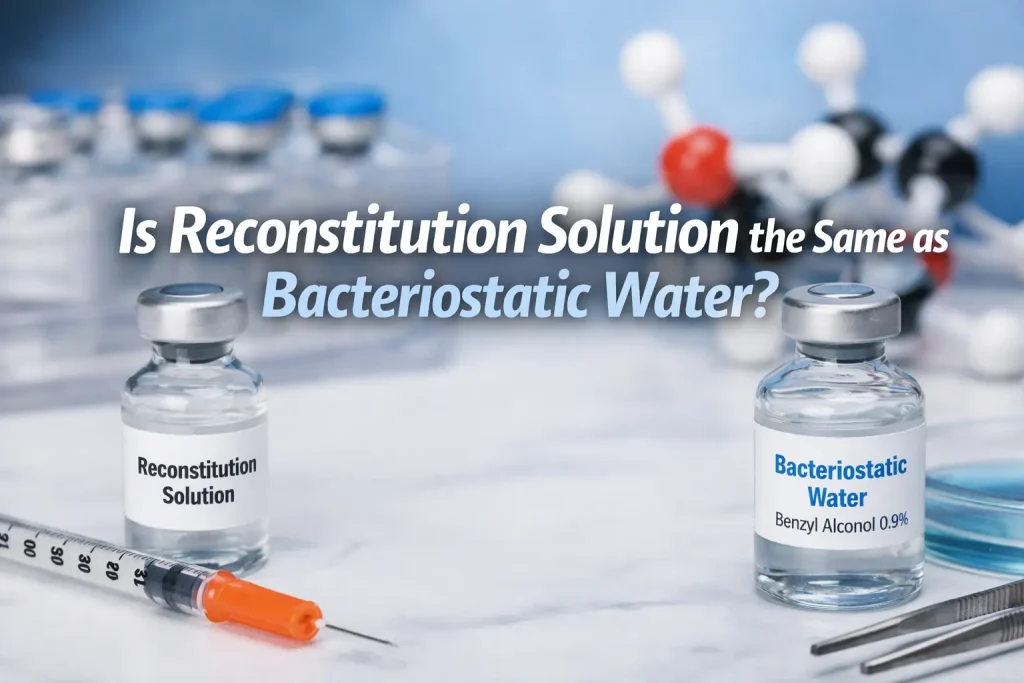
If you’re preparing peptides or medications that require mixing before use, you’ve probably come across both reconstitution solution and bacteriostatic water.
Many people assume they’re identical, but that’s not always true.
Understanding the difference helps reduce contamination risk, maintain stability, and support proper preparation.
SEE IF PEPTIDE THERAPY IS RIGHT FOR YOU
Quick Answer: Is Reconstitution Solution the Same as Bacteriostatic Water
No, reconstitution solution and bacteriostatic water are not always the same.
Bacteriostatic water is one type of reconstitution solution, but other reconstitution solutions may contain different ingredients or preservatives depending on their intended use.
When calculating your peptide dosing always check with your provider which is the correct option and dosing for your treatment.
What Is a Reconstitution Solution?
A reconstitution solution is a sterile liquid used to dissolve or dilute powdered compounds before use.
Many peptides and medications are supplied in powder form to help preserve stability during storage.
Once ready for use, the powder must be mixed with a compatible liquid known as a diluent or reconstitution solution.
Common reconstitution solutions include:
- Bacteriostatic water
- Sterile water
- Saline solution
- Specialty pharmaceutical diluents
In simple terms, reconstitution solution is a category, not a single product.
What Is Bacteriostatic Water?
Bacteriostatic water is sterile water that contains a small amount of benzyl alcohol, typically 0.9%, which acts as a preservative.
This preservative slows bacterial growth after a vial has been opened or punctured multiple times.
Because of this added protection, bacteriostatic water is commonly used when:
- Multiple doses are taken from the same vial
- The solution needs short-term storage after mixing
- Repeated withdrawals are expected
What Is Benzyl Alcohol and Why Is It Used?
Benzyl alcohol is included in bacteriostatic water to help inhibit bacterial growth inside multi-dose vials.
While it does not sterilize a solution after contamination occurs, it helps reduce bacterial multiplication between uses.
This makes bacteriostatic water especially useful when a reconstituted vial will be accessed more than once.
Reconstitution Solution vs Bacteriostatic Water: Key Differences
| Feature | Reconstitution Solution | Bacteriostatic Water |
| Definition | General term for liquids used to dissolve powders | Specific sterile water containing preservative |
| Contains preservative | Not always | Yes (benzyl alcohol) |
| Multi-dose use | Depends on solution type | Designed for multi-dose use |
| Protection against bacterial growth | Varies | Helps inhibit bacterial growth |
| Storage after mixing | Depends on diluent | Supports repeated withdrawals |
| Typical use | Medications and peptides | Peptide and medication reconstitution |
The most important takeaway is that bacteriostatic water falls under the broader category of reconstitution solutions.
Are Reconstitution Solution and Bacteriostatic Water the Same or Interchangeable?
This is where confusion commonly happens.
While bacteriostatic water can function as a reconstitution solution, not all reconstitution solutions are bacteriostatic water.
They may be interchangeable only when the reconstitution solution being referenced is bacteriostatic water itself.
Substitution may not be appropriate when:
- A preservative-free solution is required
- A saline-based diluent is specified
- The compound is sensitive to benzyl alcohol
- Immediate single-use preparation is intended
Using the wrong diluent can affect stability, storage duration, or sterility after mixing.
Common Misconception: Are They Exactly the Same?
A frequent misconception is that reconstitution solution and bacteriostatic water are simply different names for the same liquid.
In reality, reconstitution solution describes purpose, while bacteriostatic water describes a specific formulation.
Think of it this way:
- Reconstitution solution = the role
- Bacteriostatic water = one option that fulfills that role
Understanding this distinction helps prevent preparation mistakes.
Can You Use Bacteriostatic Water as a Reconstitution Solution?
Yes.
In many preparation scenarios, bacteriostatic water is commonly used as a reconstitution solution.
Its preservative allows safer handling when the same vial will be used multiple times over several days or weeks.
However, preparation instructions should always be followed when available, since compatibility varies depending on the compound.
Why the Type of Diluent Matters
The liquid used during reconstitution does more than dissolve powder.
It directly affects:
- Solution stability
- Risk of microbial growth
- Storage time after mixing
- Injection comfort
- Consistency between doses
For example, preservative-free sterile water may be appropriate for immediate use but offers little protection once opened.
Bacteriostatic water helps reduce bacterial growth risk during ongoing use.
Choosing the correct diluent supports both safety and reliability.
Sterile Water vs Bacteriostatic Water for Reconstitution
| Feature | Sterile Water | Bacteriostatic Water |
| Preservatives | None | Contains benzyl alcohol |
| Intended use | Typically single-use | Multi-dose use |
| Bacterial growth protection | No | Helps inhibit growth |
| Storage after opening | Limited | Allows repeated withdrawals |
| Common application | Immediate preparation | Ongoing dosing protocols |
Neither option is universally better, each serves a different purpose depending on how the solution will be used.
How Peptide Reconstitution Works
Reconstitution is the process of transforming a powdered compound into a liquid solution suitable for use.
The general process includes:
- Cleaning vial tops with alcohol.
- Drawing the correct amount of diluent into a syringe.
- Slowly injecting the liquid into the powder vial.
- Allowing the powder to dissolve naturally.
- Avoiding shaking, which may damage delicate compounds.
- Refrigerating after mixing if recommended.
Gentle handling helps maintain compound stability.
Common Mistakes When Reconstituting Peptides
Preparation issues often come from small but avoidable errors, including:
- Assuming all reconstitution solutions are identical
- Using sterile water for multi-dose storage unintentionally
- Injecting diluent too quickly
- Shaking instead of gently swirling
- Improper refrigeration after mixing
Consistency during preparation helps maintain solution quality.
When Is Bacteriostatic Water Typically Preferred?
Bacteriostatic water is often chosen when:
- Multiple doses will be drawn from one vial
- The solution must remain usable over time
- Reduced bacterial growth risk is desired
- Repeated vial access is expected
Its preservative component makes it practical for ongoing preparation needs.
Final Thoughts: Is Reconstitution Solution the Same as Bacteriostatic Water
While the terms are often used interchangeably, reconstitution solution and bacteriostatic water are not automatically the same thing.
Bacteriostatic water is simply one specific type of reconstitution solution designed to support safer multi-dose preparation.
Understanding the distinction helps ensure proper peptide dosing calculation, mixing, storage, and handling, reducing confusion and supporting consistent preparation practices.
Always consult your provider to determine the right dosage for your treatment plan.
FAQs: Is Reconstitution Solution the Same as Bacteriostatic Water
Can you use reconstitution solution for peptides?
Yes, peptides are commonly mixed using a reconstitution solution. The specific solution used depends on storage needs, dosing frequency, and compatibility with the peptide being prepared.
What is a reconstitution solution?
A reconstitution solution is a sterile liquid used to dissolve powdered medications or peptides so they can be properly measured and used in liquid form.
What is the difference between bacteriostatic and sterile water for reconstitution?
Bacteriostatic water contains a preservative (benzyl alcohol) that helps slow bacterial growth, making it suitable for multi-dose use. Sterile water contains no preservative and is generally intended for single-use preparation.
What are common mistakes in peptide reconstitution?
Common mistakes include using the wrong diluent, injecting liquid too quickly into the vial, shaking instead of gently swirling, improper storage after mixing, and assuming all reconstitution solutions are the same.
Why is reconstitution important for peptides?
Reconstitution allows powdered peptides to become usable in liquid form while helping maintain accurate dosing, stability, and consistency during preparation and use.
Can you make bacteriostatic water at home?
No. Proper bacteriostatic water requires sterile manufacturing conditions and precise preservative concentrations. Attempting to make it at home may introduce contamination risks.
Do I need bacteriostatic water for peptides?
Not always. Some preparations may use sterile water or other approved diluents, but bacteriostatic water is often preferred when multiple doses will be taken from the same vial.