
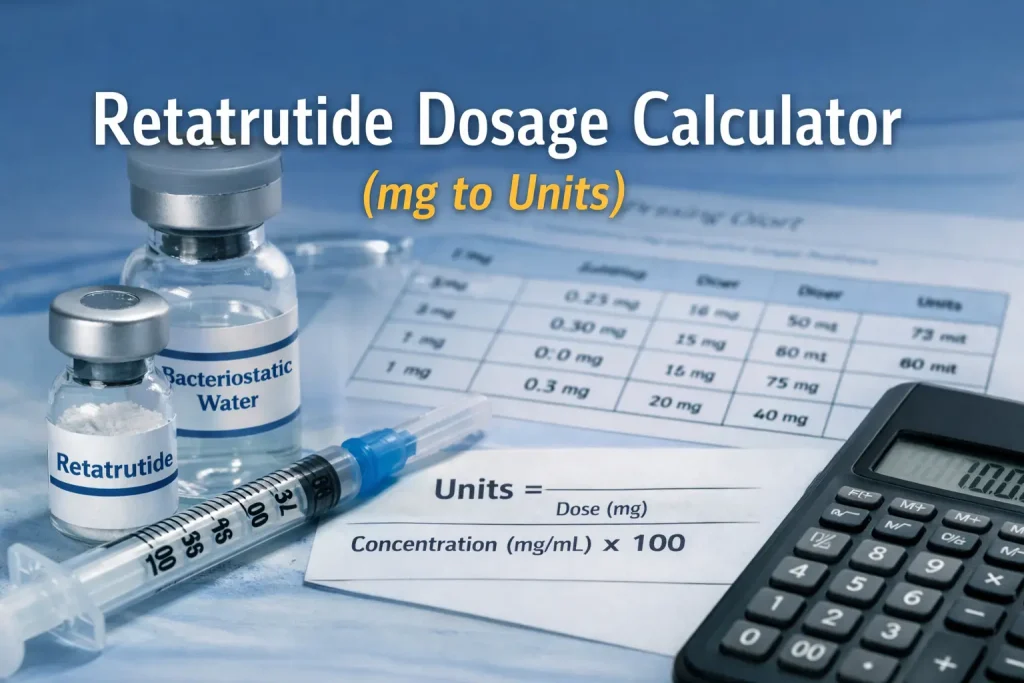
Trying to figure out how many units to inject can feel confusing at first.
Retatrutide is commonly supplied as a powder that must be mixed with bacteriostatic water before use, which means your dose must be calculated based on concentration.
This guide explains the formulas, steps, and charts needed to convert mg to units clearly and accurately.
GET HELP WITH YOUR RETATRUTIDE TREATMENT
Quick Retatrutide Dosage Calculator
Use these 3 steps to calculate your peptide dose:
- Step 1: Calculate concentration, Divide total mg in the vial by the total mL of bacteriostatic water added.
- Step 2: Divide your desired dose by the concentration
- Step 3: Multiply by 100 to convert to syringe units
This gives you the number of units to draw on a U-100 insulin syringe.
Retatrutide Dosage Calculator Formula
Once your peptide has been mixed, the following formula converts your dose from mg into syringe units:
Units = (Dose (mg) ÷ Concentration (mg/mL)) × 100
Variable definitions
- Dose (mg): The amount you intend to inject.
- Concentration (mg/mL): The strength of your solution after mixing.
- 100: Represents the number of units in a 1 mL U-100 insulin syringe.
Retatrutide Reconstitution Formula
Before calculating units, you must determine concentration:
Concentration (mg/mL) = Total mg ÷ Total mL
Example:
10 mg vial mixed with 2 mL bacteriostatic water:
10 ÷ 2 = 5 mg per mL
This concentration is used to calculate units.
Step-by-Step Retatrutide Dosage Calculation
Let’s look at a step by step guide of how retatrutide dosing is calculated:
Example
Vial amount: 10 mg
Water added: 2 mL
Desired dose: 1 mg
Step 1: Calculate concentration
10 mg ÷ 2 mL = 5 mg per mL
Step 2: Convert mg to units
1 mg ÷ 5 mg/mL × 100 = 20 units
Final Result
A 1 mg dose equals 20 units on a U-100 insulin syringe.
Retatrutide Dosage Chart
These charts provide quick reference conversions for common mixing ratios.
5 mg vial mixed with 2 mL
| Dose (mg) | Units |
| 0.25 mg | 10 units |
| 0.5 mg | 20 units |
| 1 mg | 40 units |
| 1.5 mg | 60 units |
| 2 mg | 80 units |
10 mg vial mixed with 2 mL
| Dose (mg) | Units |
| 0.25 mg | 5 units |
| 0.5 mg | 10 units |
| 1 mg | 20 units |
| 2 mg | 40 units |
| 3 mg | 60 units |
10 mg vial mixed with 5 mL
| Dose (mg) | Units |
| 0.25 mg | 12.5 units |
| 0.5 mg | 25 units |
| 1 mg | 50 units |
| 2 mg | 100 units |
Common Dose Conversions
This table compares two popular mixing ratios.
| Desired Dose | 5mg mixed with 2mL | 10mg mixed with 2mL |
| 0.25 mg | 10 units | 5 units |
| 0.5 mg | 20 units | 10 units |
| 1 mg | 40 units | 20 units |
| 1.5 mg | 60 units | 30 units |
| 2 mg | 80 units | 40 units |
These examples help verify your calculations.
Understanding Insulin Syringe Units
Most peptide injections use a U-100 insulin syringe.
Unit conversion:
1 mL = 100 units
Examples:
10 units = 0.1 mL
25 units = 0.25 mL
50 units = 0.5 mL
Units measure liquid volume, not medication weight.
The concentration determines how many units equal your dose.
Retatrutide Mixing Ratio Examples
Different amounts of bacteriostatic water create different concentrations.
| Vial Size | Water Added | Concentration |
| 5 mg | 1 mL | 5 mg/mL |
| 5 mg | 2 mL | 2.5 mg/mL |
| 10 mg | 2 mL | 5 mg/mL |
| 10 mg | 4 mL | 2.5 mg/mL |
| 10 mg | 5 mL | 2 mg/mL |
Mixing ratios that produce simple unit numbers can make measuring easier.
Typical Dosing Approach
Retatrutide dosing is commonly structured with gradual adjustments over time.
Some protocols begin with a lower amount and slowly increase depending on individual response.
Gradual adjustments allow time to assess tolerance and consistency.
Individual dosing decisions should always be guided by a qualified healthcare professional.
Important Considerations When Calculating Dosage
Always confirm the amount of bacteriostatic water added to the vial before calculating units.
Different mixing ratios produce different concentrations, which directly affects how many units equal your dose.
Using consistent measurements and double-checking calculations can help improve accuracy.
If instructions differ from your protocol, rely on the guidance provided by your healthcare professional.
Common Retatrutide Dosage Mistakes
Let’s look at some common retatrutide dosing mistakes:
Confusing mg with units
Milligrams measure the amount of medication.
Units measure liquid volume.
They are not interchangeable.
Incorrect mixing ratio
Changing the amount of bacteriostatic water changes the concentration.
Always confirm how much liquid was added before calculating.
Using the wrong syringe type
These formulas assume a U-100 insulin syringe.
Different syringes may produce different measurements.
Calculation errors
Small math mistakes can significantly change the final dose.
Using a consistent formula helps reduce errors.
Retatrutide Units Conversion Quick Reference
| Units | mL |
| 10 units | 0.1 mL |
| 20 units | 0.2 mL |
| 25 units | 0.25 mL |
| 50 units | 0.5 mL |
| 100 units | 1 mL |
Conclusion: Retatrutide Dosage Calculator
To calculate peptide dosing for retatrutide in units:
- Divide total mg by total mL to determine concentration
- Divide your dose by concentration
- Multiply by 100 to convert to units
Once concentration is known, converting mg to units becomes straightforward using the formulas and charts above.
FAQ: Retatrutide Dosage Calculator
How do you calculate retatrutide dosage?
First determine concentration by dividing total mg by total mL added. Then divide your desired dose by concentration and multiply by 100 to determine units.
What is the formula for peptide dosing?
The standard peptide dosing formula divides dose by concentration and converts the result into syringe units.
How many units equal 1 mg of retatrutide?
The answer depends on the mixing ratio. For example, if concentration is 5 mg per mL, then 1 mg equals 20 units.
Why does concentration change the number of units?
Units measure liquid volume. Changing the amount of liquid changes how much medication is contained in each unit.
How much bacteriostatic water should be added?
The amount of water added determines concentration. Different mixing ratios can be used depending on measurement preference and protocol guidance.
How much weight can you lose on retatrutide?
Weight loss results can vary depending on factors such as starting weight, dosage, consistency, nutrition, and activity level. In clinical research, participants using retatrutide experienced significant average weight reduction over time when combined with lifestyle support. Individual results may differ, and progress typically occurs gradually over several weeks or months. Consistency with your protocol and guidance from a qualified healthcare professional can help support the best possible outcome.
Disclaimer
The dosing calculator provided by BHRT Delivered is an educational tool only and is not intended for use in the diagnosis, treatment, or management of any medical condition. The outputs generated are hypothetical examples designed to illustrate calculation methods and are not prescriptions, dosing recommendations, or medical guidance.
All clinical decisions, including dosing, preparation, and administration of any peptide, bioregulator, or related molecule, must be made by a qualified healthcare professional in accordance with their professional judgment, training, and all applicable laws and regulations.
By using this tool, you acknowledge that BHRT Delivered is not responsible for any misuse of the information provided and that you remain solely responsible for compliance with all regulatory and clinical requirements.