
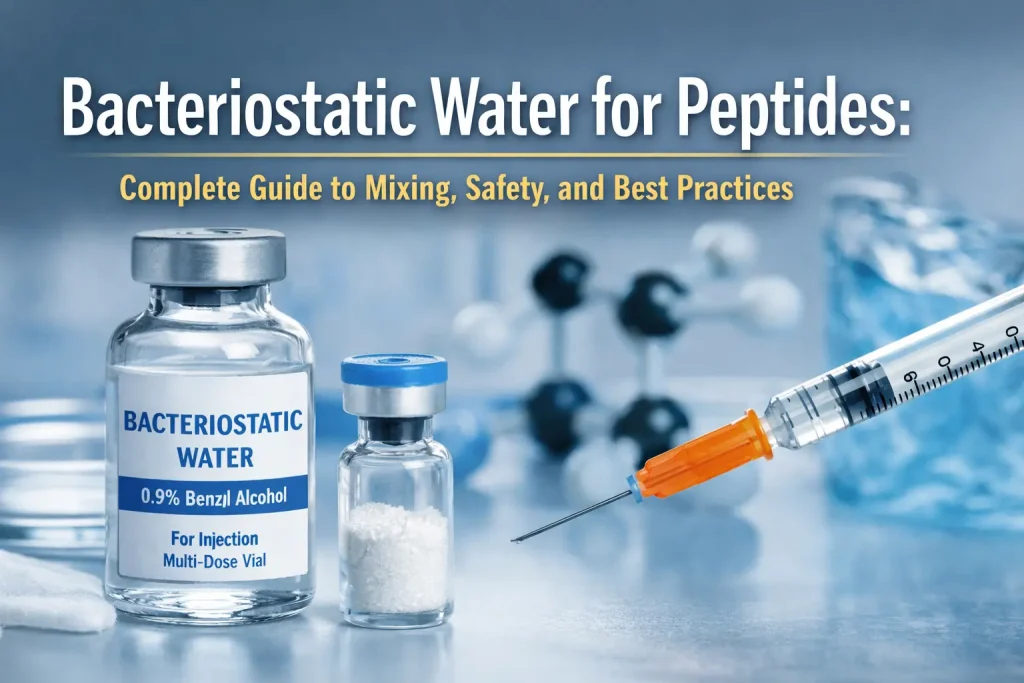
Bacteriostatic water is commonly used to reconstitute peptides before injection.
If you’re new to peptide therapy, or just want to make sure you’re doing things correctly, understanding how bacteriostatic water works, how to calculate your peptides dosage, how much to use, and how to handle it safely matters.
GET HELP WITH YOUR PEPTIDE TREATMENT
What Is Bacteriostatic Water Used for With Peptides?
Bacteriostatic water is used to reconstitute peptide powders before injection.
It contains 0.9% benzyl alcohol, which helps slow bacterial growth and allows multi-dose use when handled properly.
Once mixed, peptides can be measured accurately and administered according to a prescribed dosing plan.
What Is Bacteriostatic Water?
Bacteriostatic water is sterile water that contains 0.9% benzyl alcohol, which helps slow the growth of bacteria.
Unlike plain sterile water, bacteriostatic water can typically be used multiple times from the same vial when handled properly.
It’s commonly used in clinical settings to dilute or dissolve medications, including peptides, before administration.
Key points:
- Sterile and preservative-containing
- Designed for multi-dose use
- Helps reduce contamination risk during repeated withdrawals
Why Bacteriostatic Water Is Used for Peptides
Peptides usually come in powdered (lyophilized) form.
Before use, they must be mixed with a sterile diluent.
Bacteriostatic water is often preferred because:
- It helps reduce contamination risk: The benzyl alcohol slows bacterial growth when drawing multiple doses.
- It supports dosing accuracy: Once mixed properly, it allows for precise measurement using insulin syringes.
- It’s practical for multi-dose use: Most peptide protocols involve multiple injections over time.
How to Reconstitute Peptides With Bacteriostatic Water (Step-by-Step)
Mixing peptides correctly helps maintain stability and dosing accuracy.
Ensure that you check with your provider to ensure the correct peptide dosing calculation:
Step-by-Step Guide
- Gather supplies:
- Peptide vial
- Bacteriostatic water vial
- Alcohol wipes
- Syringe (typically insulin syringe)
- Clean vial tops: Wipe both vial stoppers with alcohol and allow them to dry fully.
- Draw bacteriostatic water: Pull back the syringe plunger to your desired volume, inject air into the bacteriostatic water vial, then draw the correct amount.
- Inject slowly into peptide vial: Insert the needle and let the water run gently down the inside wall of the vial.Avoid injecting directly onto the powder.
- Let it dissolve naturally: Do not shake. Gently swirl if needed. Most peptides dissolve within minutes.
How Much Bacteriostatic Water for Peptides? (Dosing Guide + Examples)
There isn’t one universal amount.
The right volume depends on:
- Peptide strength (mg)
- Desired dosing precision
- Injection volume preference
Make sure you check with your provider when starting your treatment to ensure the correct amount for your treatment:
Bacteriostatic Water vs Sterile Water vs Saline
Understanding the difference helps prevent dosing mistakes.
| Type | Best Use | Key Difference |
| Bacteriostatic water | Most peptides | Contains preservative for multi-dose use |
| Sterile water | Single use | No preservative |
| Saline | Certain medications | May not be ideal for some peptides |
Can you use sterile water for peptides?
Yes, but it’s typically single-use and less practical than bacteriostatic water for multi-dose protocols.
Storage, Shelf Life, and Stability
Once mixed, peptides must be handled carefully to maintain effectiveness.
General Storage Guidelines
- Refrigerate after reconstitution
- Avoid freezing unless directed
- Protect from light
How long do peptides last after mixing?
Most reconstituted peptides remain stable for about 2–4 weeks, depending on the specific peptide and storage conditions.
Discard if you notice:
- Cloudiness
- Particles
- Color changes
Common Mistakes to Avoid When Mixing Peptides
Many dosing or stability issues come down to simple errors:
- Shaking the vial: This can damage delicate peptide chains.
- Using the wrong diluent: Always confirm before mixing.
- Using tap water: Tap water is not sterile and increases contamination risk.
- Improper storage: Leaving peptides at room temperature too long reduces effectiveness.
- Injecting too quickly: This can create bubbles or foam in the vial.
When to Talk to a Provider About Peptide Mixing
Speak with a qualified provider if:
- You’re unsure about dosing calculations
- Your protocol involves multiple peptides
- You experience irritation or unusual reactions
- The solution doesn’t dissolve as expected
Clinical guidance helps ensure both safety and effectiveness.
Is Bacteriostatic Water Safe?
When used properly, bacteriostatic water is generally well tolerated.
However:
- Some individuals may be sensitive to benzyl alcohol
- It’s not recommended for neonates
- Always follow clinical guidance
If you experience unexpected reactions, consult your provider promptly.
The Bottom Line: Bacteriostatic Water for Peptides
Bacteriostatic water plays an important role in safe, accurate peptide use.
Understanding how to mix, store, and handle peptides correctly helps support both safety and effectiveness.
If you’re unsure about proper reconstitution or peptide dosing calculations, follow guidance from a qualified medical provider familiar with peptide therapy.
FAQs: Bacteriostatic Water for Peptides
Do you need bacteriostatic water for peptides?
Not always, but it’s commonly recommended. Bacteriostatic water helps slow bacterial growth and allows multi-dose use, making it practical for most peptide protocols.
Can I get bacteriostatic water over the counter?
Availability varies by location and pharmacy. In many cases, bacteriostatic water may be available without a prescription, but policies differ depending on local regulations.
What are common mistakes in peptide reconstitution?
Common mistakes include shaking the vial, using the wrong diluent, skipping alcohol prep, injecting too quickly, and storing the solution improperly.
Where is the best place to inject peptides?
Most peptides are injected subcutaneously in areas like the abdomen, thigh, or upper arm. Follow your provider’s instructions for proper technique and site rotation.
Is bacteriostatic water just sterile water?
No. Bacteriostatic water contains benzyl alcohol to slow bacterial growth, while sterile water does not contain preservatives.
Do you refrigerate peptides after reconstitution?
Yes. Most peptides should be refrigerated after mixing to help maintain stability and effectiveness.