
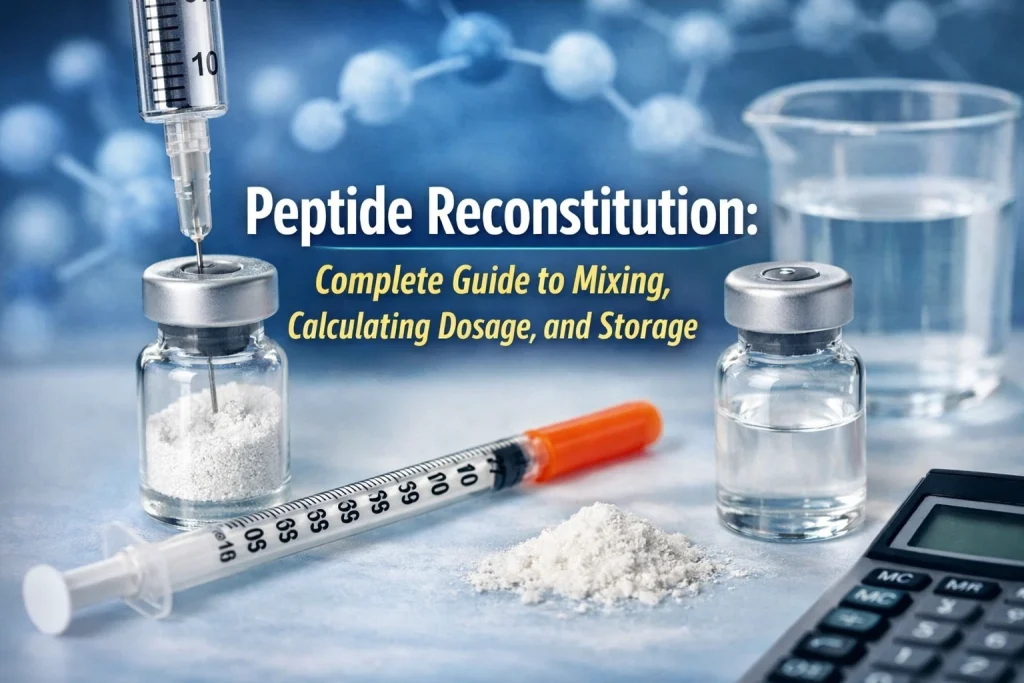
Peptide reconstitution is the process of mixing a lyophilized (freeze-dried) peptide powder with a sterile liquid, most commonly bacteriostatic water, to create a usable solution.
This allows peptides to be accurately measured and administered in precise doses.
Understanding how peptide reconstitution works is essential for safety, dosing accuracy, and maintaining peptide stability.
Whether peptide therapy is being used for hormone optimization, recovery support, or wellness therapy, proper mixing helps ensure consistency and effectiveness.
This guide explains peptide reconstitution step by step, including how to calculate peptide concentrations, how much bacteriostatic water to use, and how to store peptides after mixing.
GET THE MOST OUT OF YOUR PEPTIDE THERAPY
What Is Peptide Reconstitution?
Peptides are commonly supplied in lyophilized powder form.
Lyophilization removes moisture from the compound, helping maintain stability during transport and storage.
Before use, the peptide must be dissolved in a sterile liquid solution.
This process is known as peptide reconstitution.
Once mixed, the peptide becomes a liquid solution that can be measured using an insulin syringe or similar precision dosing device.
Why Peptides Must Be Reconstituted
Peptides are delicate molecules that can degrade when exposed to heat, light, or moisture.
Storing peptides in powder form helps preserve potency.
Reconstitution allows:
- accurate dosing
- consistent concentration
- predictable absorption
- safe administration
- extended stability when stored correctly
Improper mixing may lead to inaccurate dosing, reduced effectiveness, or unwanted side effects.
What Is Bacteriostatic Water?
Bacteriostatic water (often called bac water) is sterile water containing 0.9% benzyl alcohol.
The benzyl alcohol helps reduce bacterial growth, allowing the vial to be used more than once when handled properly.
Other diluents may include:
- sterile water
• saline solution
Bacteriostatic water is commonly preferred because it helps maintain peptide stability after reconstitution.
Peptide Reconstitution Formula
Peptide concentration depends on how much liquid is added to the vial.
Concentration = Peptide amount (mg) ÷ Diluent volume (mL)
This formula determines the strength of the final solution.
Example:
If a vial contains 5 mg of peptide and 2 mL of bacteriostatic water is added:
5 mg ÷ 2 mL = 2.5 mg per mL
Each milliliter of solution contains 2.5 mg of peptide.
Peptide Dilution vs Peptide Reconstitution
The terms peptide dilution and peptide reconstitution are sometimes used interchangeably, but they are slightly different.
Reconstitution refers to adding liquid to a lyophilized peptide powder so it can be used.
Dilution refers to adjusting the strength of a solution by increasing the amount of liquid.
For example:
Adding 1 mL of bacteriostatic water creates a stronger concentration than adding 3 mL.
Both concepts influence dosing accuracy.
Step-by-Step Peptide Reconstitution Instructions
Let’s take a look at how to reconsitute peptides:
Step 1: Gather supplies
You will need:
- peptide vial
- bacteriostatic water
- alcohol wipes
- sterile syringe
- insulin syringe
Step 2: Clean vial tops
Use an alcohol swab to disinfect the rubber stoppers on both the peptide vial and bacteriostatic water vial.
Step 3: Draw bacteriostatic water
Use a sterile syringe to draw the desired amount of bacteriostatic water.
Step 4: Inject water slowly
Insert the needle into the peptide vial and slowly inject the bacteriostatic water down the side of the vial.
Avoid injecting directly onto the powder, as this may damage peptide structure.
Step 5: Allow the powder to dissolve
Do not shake the vial.
Instead, gently swirl the vial until the powder fully dissolves.
Shaking can affect peptide stability.
Step 6: Store properly
After mixing, store the peptide in the refrigerator unless otherwise directed.
Understanding mg vs mcg vs mL in Peptide Reconstitution
Understanding measurement units helps ensure accurate dosing.
mg (milligrams) measures the amount of peptide.
mL (milliliters) measures liquid volume.
mcg (micrograms) is another measurement of peptide weight.
Conversion:
1 mg = 1000 mcg
Example:
0.25 mg = 250 mcg
0.5 mg = 500 mcg
Understanding these conversions helps ensure dosing precision.
Peptide Reconstitution Chart
| Peptide Amount | Bac Water Added | Concentration |
| 5 mg | 1 mL | 5 mg per mL |
| 5 mg | 2 mL | 2.5 mg per mL |
| 5 mg | 3 mL | 1.67 mg per mL |
| 10 mg | 1 mL | 10 mg per mL |
| 10 mg | 2 mL | 5 mg per mL |
| 10 mg | 3 mL | 3.33 mg per mL |
Insulin Syringe Units Conversion Chart
Many peptides are measured using insulin syringes.
| Syringe Units | Volume (mL) |
| 10 units | 0.1 mL |
| 20 units | 0.2 mL |
| 30 units | 0.3 mL |
| 50 units | 0.5 mL |
| 100 units | 1 mL |
This chart helps convert dosing instructions into syringe measurements.
How Much Bacteriostatic Water Should You Add to Peptides?
The amount of bacteriostatic water added depends on:
- desired concentration
- dosing preference
- injection comfort
- provider guidance
Adding more liquid creates a lower concentration, which may allow more precise dosing adjustments.
Adding less liquid creates a stronger concentration, requiring smaller injection volumes.
Many providers recommend adding between 1 mL and 3 mL per vial.
Why Accurate Peptide Reconstitution Matters for Therapy
Accurate peptide mixing helps maintain consistent dosing.
Proper concentration allows providers to:
- adjust dosage gradually
- maintain predictable results
- reduce risk of side effects
- preserve peptide stability
Small calculation errors can significantly change dose strength, which may affect outcomes.
Consistency supports better treatment experiences.
Peptide Storage After Reconstitution
Proper storage helps maintain peptide stability.
General storage recommendations include:
- refrigerate after mixing
- avoid excessive heat exposure
- protect from light
- avoid repeated temperature changes
Many peptides remain stable for several weeks when stored correctly, but stability varies depending on the specific peptide.
Follow provider instructions when available.
Common Peptide Reconstitution Mistakes
Let’s look at some common mistakes to avoid with peptide reconstitution:
- Using incorrect diluent volume: Incorrect calculations may affect dosing accuracy.
- Shaking the vial: Shaking may damage delicate peptide chains.
- Using non-sterile supplies: Sterility helps reduce contamination risk.
- Improper storage temperature: Exposure to heat may reduce peptide effectiveness.
- Injecting bacteriostatic water too quickly: Rapid injection may cause foaming.
GET HELP WITH YOUR PEPTIDE THERAPY
Conclusion: Peptide Reconstitution
Whether you are new to peptide therapy or looking to improve your understanding of peptide dosing calculations, learning the fundamentals of peptide reconstitution helps support a smoother and more predictable experience.
When in doubt, working with a knowledgeable provider like BHRT Delivered can help ensure the correct mixing ratio, dosing guidance, and storage practices for your specific peptide protocol.
FAQ: Peptide Reconstitution
How many mL of bacteriostatic water to mix with peptides?
The amount of bacteriostatic water depends on the desired concentration and dosing preference. Many providers recommend adding between 1 mL and 3 mL of bacteriostatic water per vial. Adding more liquid creates a lower concentration, allowing for more precise dose adjustments, while adding less liquid creates a stronger concentration that requires a smaller injection volume.
How long do you let peptides reconstitute?
Most peptides dissolve within a few minutes after bacteriostatic water is added. After injecting the liquid into the vial, allow the peptide powder to dissolve naturally by gently swirling the vial. Avoid shaking, as agitation may damage delicate peptide chains. Wait until the solution appears fully clear before use.
What is the formula for reconstitution?
Peptide concentration is calculated by dividing the amount of peptide in milligrams by the amount of liquid added in milliliters. For example, if a vial contains 5 mg of peptide and 2 mL of bacteriostatic water is added, the final concentration is 2.5 mg per mL.
Do you refrigerate peptides before reconstituting?
Lyophilized peptides are often stored in a cool, dry place before reconstitution, though some providers recommend refrigeration to maintain stability. After reconstitution, most peptides should be refrigerated to help preserve potency and reduce degradation over time.
How to reconstitute peptides correctly?
To reconstitute peptides correctly, clean the vial tops with alcohol, draw the desired amount of bacteriostatic water using a sterile syringe, and slowly inject the liquid down the side of the peptide vial. Allow the powder to dissolve naturally by gently swirling the vial. Do not shake the vial, and store the reconstituted peptide in the refrigerator unless instructed otherwise.
Disclaimer: The article delivered is an educational tool only and is not intended for use in the diagnosis, treatment, or management of any medical condition. The outputs generated are hypothetical examples designed to illustrate calculation methods and are not prescriptions, dosing recommendations, or medical guidance.
All clinical decisions, including dosing, preparation, and administration of any peptide, bioregulator, or related molecule, must be made by a qualified healthcare professional in accordance with their professional judgment, training, and all applicable laws and regulations.
By using this tool, you acknowledge that BHRT Delivered is not responsible for any misuse of the information provided and that you remain solely responsible for compliance with all regulatory and clinical requirements.